How to Load Consumer Electronics into a Container Without Damage
- A 40HC holds ~67 CBM and ~26,000 kg payload — but practical electronics fill is 58–64 CBM once pallets and stacking rules are applied.
- Palletize flat screens and fragile goods; floor-load only sturdy, uniform cartons with a written stacking plan.
- Respect the carton's stacking limit and load heavy items on the floor, light/fragile on top.
- Use airbags, corner boards and 6–12 desiccant strips per 40HC to fight vibration and condensation.
- Get a photo-recorded loading plan before the doors close — it is your evidence in any claim.
To load consumer electronics into a container without damage, build a written loading plan from actual carton dimensions, palletize fragile goods, respect stacking limits, brace every void, and control moisture with desiccants. The container itself is rarely what damages electronics — compression, vibration and condensation during 20–35 days at sea are. Here is how our loading teams handle it, with real CBM examples.
The claims data we see mirrors what marine insurers such as the TT Club report industry-wide: a large share of cargo damage traces back to poor packing and loading inside the box, not to the ocean voyage itself. A USD 2,000 loading plan is the cheapest insurance electronics money can buy.
Know Your Box: Container Specs That Matter for Electronics
| Container | Internal volume | Payload (typical) | Electronics fill reality |
|---|---|---|---|
| 20GP | ~33.2 CBM | ~28,200 kg | 28–30 CBM practical; for dense cargo (adapters, chargers) |
| 40GP | ~67.7 CBM | ~26,500 kg | 55–60 CBM practical |
| 40HC | ~76.4 CBM | ~26,500 kg | 58–64 CBM practical |
Why the gap between nominal and practical? Cartons aren't perfect cubes, door frames eat one row, and pallets consume ~12–15% of volume. For most electronics, weight is not the constraint — cube is. A 40HC of mid-range kitchen appliances might cube out at 20 tonnes; a 40HC of phone chargers might cube out at only 9 tonnes. If you're unsure which container fits your order, our 20GP vs 40GP vs 40HC guide walks through the trade-offs.
Step 1: Build a CBM Loading Plan from Real Carton Dimensions
Never accept "it should fit" from a factory. Get each SKU's exact carton size (L×W×H in cm), gross weight and stacking limit, then compute the plan. Example — a mixed order of small electronics from Dongguan:
| Item | Carton (cm) | CBM/carton | Qty cartons | Total CBM | Gross kg | Stack max |
|---|---|---|---|---|---|---|
| Bluetooth speakers (12 pcs/ctn) | 58×45×38 | 0.099 | 210 | 20.8 | 3,780 | 6 layers |
| USB-C chargers (40 pcs/ctn) | 50×40×35 | 0.070 | 180 | 12.6 | 3,240 | 8 layers |
| LED desk lamps (6 pcs/ctn) | 62×42×45 | 0.117 | 120 | 14.1 | 2,880 | 5 layers |
| Pallet footprint (18 pallets) | — | — | — | ~8.5 | 540 | — |
| Totals | — | — | 510 | ~56.0 | ~10,440 | — |
At 56 CBM of 67.7 available, this load leaves 8–10 CBM of contingency for airbags, dunnage and imperfect stacking — exactly the buffer a good plan keeps. Loading a container past 95% of nominal cube is how cartons get crushed at the door line.
Step 2: Choose Palletized vs Floor-Loaded — Honestly
- Palletize flat-screen TVs, monitors, laptops in retail-ready cartons, and anything fragile or mixed-SKU. Standardize on 1.1×1.1 m pallets (fit 2 across a container's width), shrink-wrap fully, and strap corner boards. Pallets cost USD 6–12 each — trivial against the value they protect.
- Floor-load only uniform, sturdy cartons (chargers, cables, small audio) when you need the extra 10–15% cube. Then the stacking plan is non-negotiable: heavier cartons at the bottom, interlock the pattern like brickwork, cap layers per the carton print, and brace the top layer so nothing shifts when doors close.
Step 3: Respect Stacking Limits and Compression Physics
Each carton's stacking limit is a compression spec, not a suggestion. Two rules our teams apply:
- Load through corners, not faces. Cartons must sit squarely on top of each other so the vertical load travels down the walls and corners. One overhanging carton concentrates the whole column's weight on a foam-lined face — that's how 200 monitors get cracked without a single dent on the outer box.
- Split long columns with layer sheets. Corrugated layer sheets every 3–4 layers distribute weight and stop the bottom carton from becoming the container's structural floor.
Mini-case: the rolled TV shipment
In July 2026, a UK buyer's forwarder floor-loaded 480 cartons of 32-inch TVs together with 6 tonnes of cast-iron cookware "to save a container." Result: 61 cracked panels, a disputed claim, and a 6-week resupply gap before Christmas stock. The fix had cost USD 180: palletize the TVs, top-load them, keep cookware floor-loaded in the same box. We rebuilt the plan for the reshipment — 1 pallet row of TVs above the cookware, airbags between zones — and the reshipment arrived with zero damage. Claims against carriers are capped at roughly USD 500 per container under Hague-Visby rules, so without all-risks cargo insurance, that loss would have been almost entirely uninsured.
Step 4: Brace, Fill Voids and Fight Vibration
- Inflatable kraft airbags (2–4 per 40HC) between cargo blocks and container walls — the single best anti-shift investment.
- Void fill with corrugated or foam for any gap over 10 cm; cartons that can move will move.
- Load bars or lumber gates to partition zones when one container carries multiple buyers' consolidated goods.
- "This side up" and "fragile" markings on every applicable carton — most destination crews respect them; unmarked cartons get none of that courtesy.
Step 5: Control Moisture — the Silent Killer
A sealed container is a humidity trap. During a Shanghai–Rotterdam crossing, nights cool the steel walls and moisture from wooden pallets and cartons condenses inside — "container rain." For electronics:
- Hang 6–12 desiccant strips per 40HC (more for winter Europe lanes and rainy-season South China loadings);
- Use kiln-dried or plastic pallets, never wet or mold-stained wood;
- Keep anti-static bags sealed inside export cartons;
- Ensure wood packaging carries the ISPM-15 stamp to avoid quarantine holds.
Our seasonal guide covers this in depth: do you need desiccants in your container?
Step 6: Verify VGM and Document Everything
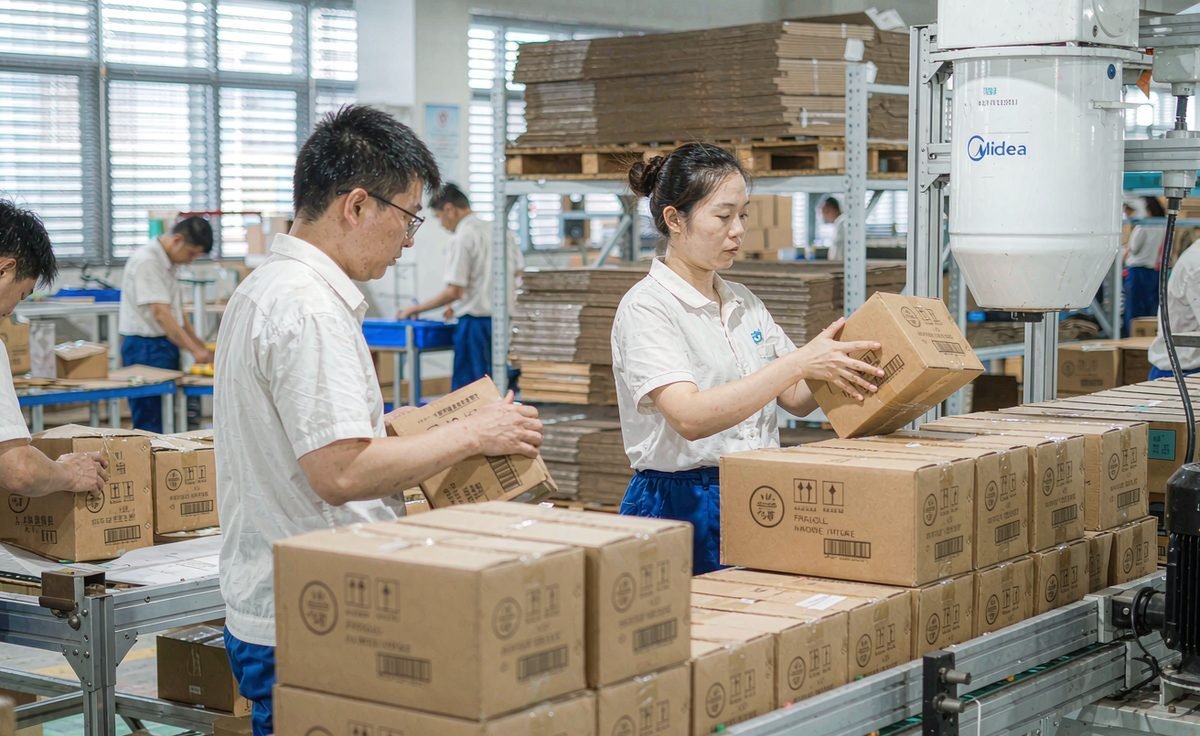
Since SOLAS rules took effect, no container ships without a verified gross mass (VGM) declaration — the shipper's weighed total including dunnage and pallets. Overweight boxes face late VGM fees or rollover. And before doors close, photograph: empty container, floor cargo, each completed layer, bracing, door-face stack, and the seal number. That 20-photo record is what wins a claim — our cargo damage claim guide explains why loading evidence is decisive.
A Tier Plan Example: Building the Load Floor First
Once your CBM totals are set, translate them into a vertical plan — which tier carries what. Electronics loading follows a simple hierarchy: heaviest and sturdiest at the floor, medium cartons in the middle, fragile retail-display goods at the top, and nothing protruding past the door line. Here is the tier plan for the Dongguan mixed order from the table above:
| Tier | Height | Cargo | Rationale |
|---|---|---|---|
| Floor tier (2 layers) | 0–70 cm | USB-C charger cartons (heaviest per carton) | Highest compression tolerance; anchors the load |
| Middle tier (3 layers) | 70–185 cm | Bluetooth speaker cartons, interlocked | Sturdy but retail-packaged; mid-height protects from floor moisture |
| Top tier (2 layers + sheet) | 185–240 cm | LED desk lamps, layer sheet below | Lightest, most fragile; short haul to ceiling minimizes stack mass above |
| Door face | full height | Strap to lashing points; airbag at 2/3 height | Prevents door-face collapse on opening |
Note the ceiling: at ~240 cm the load leaves 60–90 cm of headroom in a standard 40HC (internal height ~2.69 m). Resist the urge to build to the roof — a compressed top layer against the ceiling transmits every vessel roll straight into your most fragile cartons, and destination crews need working room to unload without hooking a carton edge.
Seven Loading Mistakes That Generate Electronics Claims
- Trusting the factory's "it always fits." Factories optimize for their carton counts, not for your claim rate. Get the dimensions and compute independently.
- Loading with the container on a slope. A tilted chassis means every "level" layer is angled; columns lean and shift. Insist on a level yard surface.
- Skipping corner boards on palletized monitors. Strapping directly over carton edges cuts into corrugation under 1 tonne of strap tension.
- Mixing heavy accessories under electronics. A 400 kg pallet of adapters below speaker cartons is fine; a 900 kg one is not. Cap the floor tier at ~350–450 kg/m².
- Leaving the last pallet row loose at the door. Unbraced door-face cargo shifts on the first hard brake from the terminal. Strap or gate it.
- No desiccants in rainy-season loadings. May–September in South China loads humid air into every box; the condensation cycle does the rest.
- No photo record. When 40 cartons arrive crushed, the question "who loaded it like this?" is answered by whoever has photos. Make sure it's you.
Factory Loading vs Supervised Loading: What You're Actually Buying
You have three loading models, priced differently and carrying different risk:
- Factory self-loading: free, fast, and variable. Acceptable for repeat SKUs with a proven packing record. Require the standard 20-photo set anyway.
- Forwarder supervised loading: a loading supervisor checks the plan tier-by-tier, photographs everything, verifies marks and desiccants, and refuses bad stacking before the doors close. Typically USD 80–150 per container around Shenzhen and Ningbo.
- CFS stuffing (for LCL): the consolidator builds the box from multiple buyers' cargo. Here your control is limited to packaging quality and written position instructions — which is exactly why LCL for fragile electronics demands a top-load commitment.
For a first shipment with a new electronics factory, supervised loading is cheap tuition: it surfaces packaging weaknesses while there's still time to fix them before the container sails. On established lanes with proven suppliers, photo verification usually suffices.
Frequently Asked Questions
How many consumer electronics cartons fit in a 40HC container?
A 40HC offers about 67–68 CBM of internal volume and roughly 26,000–28,000 kg of payload. Practical fill for electronics is 58–64 CBM depending on carton uniformity and pallet use. Always compute your plan from actual carton dimensions and cap gross weight at the carrier's VGM limit.
Should consumer electronics be palletized or floor-loaded?
Palletize whenever possible. Pallets standardize stacking, protect against crush from co-loaded freight and speed up handling. Floor-loading gains 10–15% more cube but only makes sense for sturdy, uniformly sized cartons with a certified stacking plan. Flat-screen TVs should always be palletized, this-side-up.
How high can you stack electronics cartons in a container?
Follow the carton's printed stacking limit, typically 3–5 layers for TV and monitor cartons and 5–8 for sturdy small-device cartons. Build the stack so lower cartons carry the load through their corners and walls, never through the middle, and use corner boards and layer sheets to spread compression.
Do I need desiccants when shipping electronics by sea?
Yes, in most seasons. A closed container crossing the ocean cycles through temperature swings of 15–20°C, causing condensation on interior surfaces. Use 6–12 container desiccant strips for a 40HC depending on season and route, keep cartons sealed, and avoid shipping electronics on wet wooden pallets.
- How to Load Home Appliances into a Container Without Damage
- How to Load Hardware & Tools into a Container Without Damage
- How to Load Toys & Baby Products into a Container Without Damage
- How to Load Cosmetics & Beauty Products into a Container Without Damage
- How to Load Phone Accessories into a Container Without Damage
- How to Load Pet Supplies into a Container Without Damage
Get Today's Rate & Lock Your Discount
Waymore Shipping offers FCL & LCL ocean freight from every major port in China — Shanghai, Ningbo, Shenzhen, Guangzhou, Qingdao, Xiamen, Tianjin and more. Rates updated weekly with carrier discounts.