Shipping Plastic Products from China: The Complete Exporter's Guide
- Shipping plastic products from China is a cube game: volume, not weight, sets your cost — packaging design is your biggest lever.
- Cluster-to-port mapping: Taizhou/Yuyao → Ningbo, Dongguan/Foshan → Yantian or Nansha, Shandong film → Qingdao.
- Heat and moisture warp and stain plastics in transit; carton packing, desiccants and below-deck stowage solve it.
- Food-contact plastics need FDA or EU 10/2011 proof; buyers should demand migration test reports, not assurances.
- Consolidating multiple plastic factories into one 40HC typically beats separate LCL lots by 20–30% on cost per unit.
Shipping plastic products from China succeeds or fails on one variable: how efficiently your supplier's packaging fills the container. Plastic goods are light and bulky, so you pay for volume rather than weight — the winners nest, compress and stack their way to 90%+ cube utilization, while everyone else ships air. This guide covers packaging, ports, transit risks and compliance with real numbers.
We ship plastic housewares, storage bins, kitchenware and industrial plastic components out of Ningbo, Nansha and Qingdao every week. The category is low-value per kilogram, which means freight is a larger slice of your landed cost than in almost any other consumer category — small logistics improvements move your margin.
Where Plastic Is Made — and Which Port to Use
China's plastic production is highly clustered, and matching cluster to port saves both trucking cost and days:
| Cluster | Typical products | Best port | Trucking time |
|---|---|---|---|
| Taizhou / Yuyao / Cixi (Zhejiang) | Housewares, storage bins, bottle preforms | Ningbo | 1–3 hours |
| Dongguan / Foshan / Shenzhen (Guangdong) | Kitchenware, toys-adjacent plastics, electronics housings | Yantian / Nansha | 1–2 hours |
| Shandong (Qingdao / Weifang) | Plastic film, woven bags, industrial sheet | Qingdao | 1–4 hours |
| Fujian (Quanzhou / Xiamen) | Footwear components, household items | Xiamen | 1–3 hours |
Because plastics are cheap per kilo, inland trucking and origin fees are proportionally heavy in landed cost. A supplier 30 minutes from Ningbo beats a 5% cheaper supplier four hours inland once drayage and time are counted — run that math before awarding orders.
Packaging: The Real Cost Driver
For every other heavy category, packaging protects cargo. For plastics, packaging is cargo — bad design ships air. The standards we push suppliers toward:
- Nested geometry: bins, bowls and planters designed to nest save 20–40% of carton volume versus non-nesting equivalents
- Compressed soft goods: laundry baskets, folding crates and EVA items ship better slightly nested with minimal void fill
- Stackable cartons: specify uniform carton sizes and a max stack height the carton's ECT rating supports; mixed carton sizes waste 8–12% of cube
- Master carton discipline: keep cartons 10–18 kg so stack pressure stays safe and destination handling stays cheap
- Polybags with warnings: thin polybags on toys/suction-prone items need suffocation warnings for US retail
Not sure how much your cartons actually fit? Our guide to how much fits in a 40ft container includes the estimation method, and the CBM and chargeable weight formula shows how LCL bills bulky plastics — usually painfully on volume.
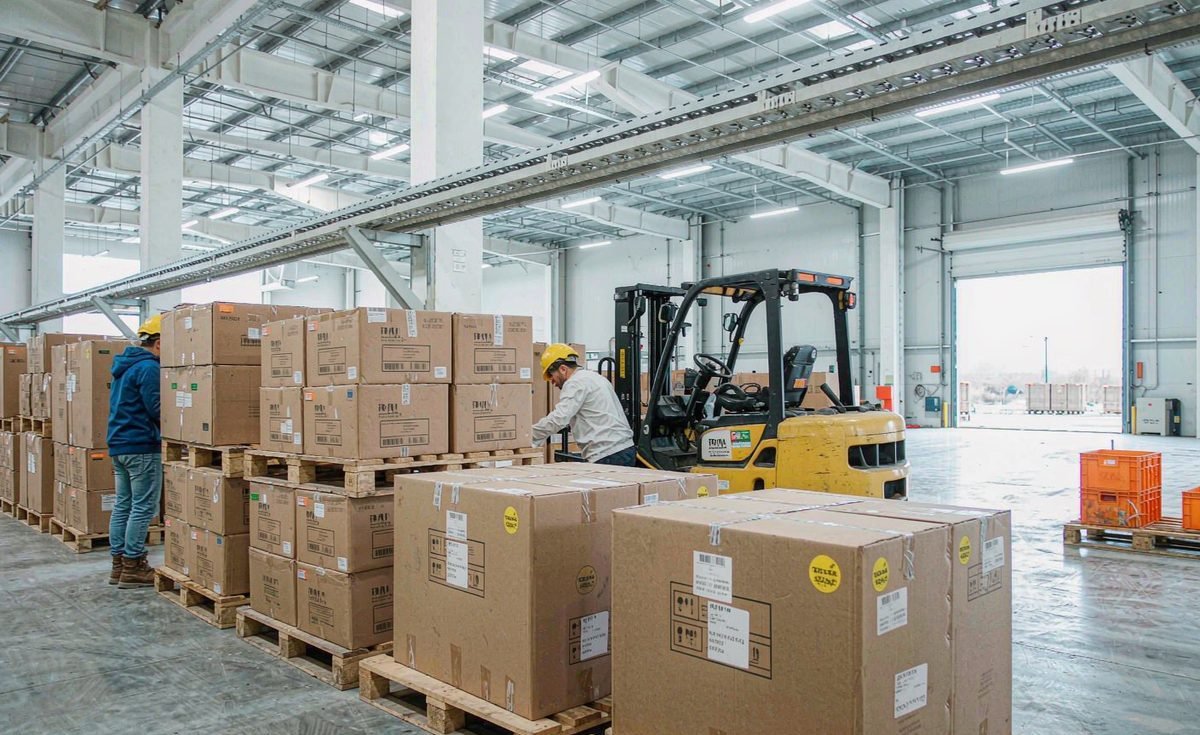
Container Utilization: A Worked 40HC Example
Real load from November 2026: a US housewares buyer shipped a mixed order from three Taizhou factories, consolidated into one 40HC from Ningbo to Los Angeles:
- 2,400 nested storage bins in 200 cartons (0.115 CBM each) = 23 CBM / 3,100 kg
- 6,000 kitchen utensil sets in 150 cartons (0.08 CBM) = 12 CBM / 2,700 kg
- 1,800 wall-mounted organizers in 90 cartons (0.14 CBM) = 12.6 CBM / 2,400 kg
- 4,000 mixing bowls in 120 cartons (0.09 CBM) = 10.8 CBM / 2,000 kg
Total: 58.4 CBM and only 10,200 kg in a 76 CBM 40HC — the cube, not weight, dictated everything. Floor-loaded in brick-wall pattern with airbags, the load achieved 77% container utilization; with tighter carton standardization the same order would exceed 85%. Compare that to the alternative — three separate LCL lots would have added roughly $900 in combined origin and destination handling for the same cargo.
Heat, Moisture and the Ocean Environment
Plastics fail in transit by deformation, staining and odor — not by crushing. Three environmental facts shape the load plan:
- Deck heat: containers on summer decks can exceed 50°C internally; thin-wall PP and PVC items warp. Request below-deck stowage for deformation-prone cargo where the service allows, and never pack products fresh from molding presses — let them cure 24 hours.
- Condensation ("container rain"): 30+ day lanes (Ningbo–Santos, Qingdao–Hamburg) need 6–8 desiccant bags per 40HC and kraft floor liner; water-stained cartons read as damaged goods at retail.
- Odor migration: strong-smelling plastics (recycled HDPE, certain PVC) taint food-contact cargo shipped alongside — segregate within the container or within the order.
On lanes through the Gulf or Red Sea in summer, we also advise against black and dark-colored thin-film products loaded against container walls — heat absorption concentrates at contact points.
Compliance: Food-Contact Plastics Are the Main Event
Most plastic housewares face light customs friction, but food-contact items carry real regulatory weight at destination:
| Destination | Food-contact rule | What the importer needs | Other plastic rules |
|---|---|---|---|
| United States | FDA food-contact substances (21 CFR 177) | Supplier compliance letters; migration testing for higher-risk items | California Prop 65 labeling for certain additives; CPSC rules if toy-adjacent |
| European Union | Regulation (EU) 10/2011 | Declaration of Compliance + migration test reports | REACH (SVHC) statements; packaging waste duties (EPR) |
| United Kingdom | Mirrors EU 10/2011 post-Brexit | Same DoC format accepted | UK REACH; plastic packaging tax on UK-side packaging |
| Australia / NZ | FSANZ-aligned requirements | Supplier declarations | ACCC safety rules; strict quarantine cleanliness |
For US-bound food-contact lines, the FDA's import guidance explains what documentation FDA investigators may request at entry. Practical rule: get the migration test report from an accredited lab (SGS, Intertek, TÜV) at order placement, not at customs — retesting a rejected line costs 6–10 weeks.
FCL vs LCL for Plastics — and the Consolidation Edge
Bulky plastics hit the LCL crossover earlier than dense goods: above roughly 12–14 CBM, a 40HC (or shared 40HC via consolidation) beats LCL, because LCL destination charges scale with CBM and plastic orders are CBM-heavy. Under 10 CBM, LCL from Ningbo or Yantian works fine if the freight is palletized or well-cartoned. The bigger structural win is consolidation: in a typical week we consolidate 40+ LCL shipments into shared containers, and plastic buyers with 3–6 suppliers in one cluster routinely cut 20–30% from their freight line by pooling into single containers — see our multi-supplier consolidation guide. Buyers sourcing small lots through 1688 can also use our 1688/Taobao consolidation service to pull samples and trial orders into one weekly box.

Transit Times and Seasonal Planning
Reference port-to-port transits: Ningbo → Los Angeles 13–16 days on premium loops, 16–20 standard; Ningbo → Rotterdam 28–33 days; Qingdao → Sydney 14–18 days; Nansha → Jebel Ali 18–22 days. Plastics ship in enormous volume before retail season and before Chinese New Year — mid-November through January, space tightens and light bulky cargo is the first to be rolled when vessels are full. Book 2–3 weeks ahead in that window; our pre-CNY booking guide covers cut-off planning, and the seasonal pricing cycle is mapped in our freight season calendar.
When Does Air Freight Make Sense for Plastic Products?
Rarely for bulk, often for the moments around it. Plastic products bill on volumetric weight at 1 CBM = 167 kg, so light bulky goods pay a heavy price per unit in the air — a carton of 30 storage bin lids weighing 6 kg but measuring 0.09 CBM bills as 15 kg. The cases where air still wins: pre-production samples for buyer review (5–8 days Shanghai to Los Angeles at $5–8/kg), launch stock where a new SKU must fill retail shelves before a 30-day ocean replenishment can arrive, and small high-value components — precision gears, medical-grade polymers, cosmetic packaging — where the value-to-weight ratio defeats the volumetric penalty. For everything else, the discipline is ocean plus better forecasting: our comparison of air versus sea freight includes the breakeven math. One plastics-specific tip: vacuum-compressed soft goods (laundry hampers, padded mats) sometimes fly economically precisely because compression kills their volumetric weight — the same compression that saves ocean cube.
A Carton Specification Checklist to Send Your Supplier
Most cube and damage problems in plastics trace back to carton specs the buyer never set. Put these in the purchase order:
- Uniform carton sizes: three standard sizes across the order maximum — mixed sizes cost 8–12% of container cube
- Weight band: 10–18 kg per carton; heavier cartons risk stack failure, lighter ones waste corrugate
- ECT/strength requirement: double-wall for cartons bearing load, and state the max stack height the design supports
- Nesting confirmation: photos of nested product inside each carton before mass production
- Polybag warnings: suffocation warning text for any bag 4 mil or thinner in US-bound retail goods
- Moisture barrier: poly liner or shrink groups for long-lane shipments
- Carton markings: SKU, quantity, gross weight, and destination marks matching the packing list exactly
Suppliers meet specs they are given in writing. A one-page spec sheet costs nothing and routinely improves cube utilization by 5–10 points — on light cargo, that is pure freight margin.
EPR and Packaging Rules: The New Destination Cost Layer
Plastic importers now face a second compliance layer beyond product rules: packaging producer responsibility. The EU's packaging directives, implemented nationally (Germany's VerpackG with its LUCID registration is the strictest), require importers of packaged goods to register and fund packaging recycling — non-registration is now an enforcement matter, and marketplaces like Amazon verify it for EU sellers. The UK's packaging EPR scheme and plastic packaging tax add equivalent obligations on UK-side importers. These costs do not appear in your freight quote — they appear in your destination compliance budget, and they scale with exactly the carton-heavy volumes plastics ship in. Minimize billable packaging weight, use mono-material cartons, and confirm your destination registration status before your first container, not after the first notice letter.
Frequently Asked Questions
What is the biggest cost issue when shipping plastic products from China?
Plastic products are light and bulky, so volume is almost always the binding constraint — you pay for cube, not weight. A 40HC of housewares may weigh only 6–8 tonnes while filling 65+ CBM. The fix is packaging: nesting designs, compressed cartons and stacking-friendly shapes can raise the effective cube utilization from 70% to 90%+, cutting freight cost per unit by double-digit percentages.
Which Chinese ports are best for plastic product exports?
Ningbo serves the Taizhou, Yuyao and Cixi plastic manufacturing belt with 1–3 hour trucking and dense LCL consolidation. The Pearl River Delta cluster around Dongguan, Foshan and Shenzhen ships via Yantian or Guangzhou Nansha. Qingdao handles Shandong's plastic film and industrial products. Choose the port nearest the cluster — plastic is low-value-dense, so inland trucking is a bigger share of landed cost than for most cargo.
Do plastic products get damaged by heat inside containers?
Yes. Inside a container on a summer deck, cargo temperatures can exceed 50°C, which warps thin-walled injection-molded items, deforms EVA and PVC products, and can trigger migration of plasticizers. Pack heat-sensitive items in cartons, never direct-load against container walls or roof, avoid stacking freshly molded (still warm) products, and request below-deck stowage for deformation-prone cargo.
What compliance applies to food-contact plastic products?
Food-contact plastics need destination-specific proof: US importers need FDA food-contact compliance (21 CFR 177 materials), the EU requires Regulation (EU) 10/2011 compliance with a Declaration of Compliance, and the UK mirrors EU rules post-Brexit. Buyers increasingly demand third-party migration test reports. Non-food-contact items face lighter rules but may still need REACH compliance for the EU market.
- Shipping Agricultural Machinery from China: The Complete Exporter's Guide
- Shipping Solar Panels & PV Equipment from China: The Complete Guide
- Shipping Ceramics & Tableware from China: The Complete Exporter's Guide
- Shipping Sporting Goods from China: The Complete Exporter's Guide
- Shipping Industrial Chemicals from China: The Complete Exporter's Guide
- Shipping Building Materials from China: The Complete Exporter's Guide
Get Today's Rate & Lock Your Discount
Waymore Shipping offers FCL & LCL ocean freight from every major port in China — Shanghai, Ningbo, Shenzhen, Guangzhou, Qingdao, Xiamen, Tianjin and more. Rates updated weekly with carrier discounts.